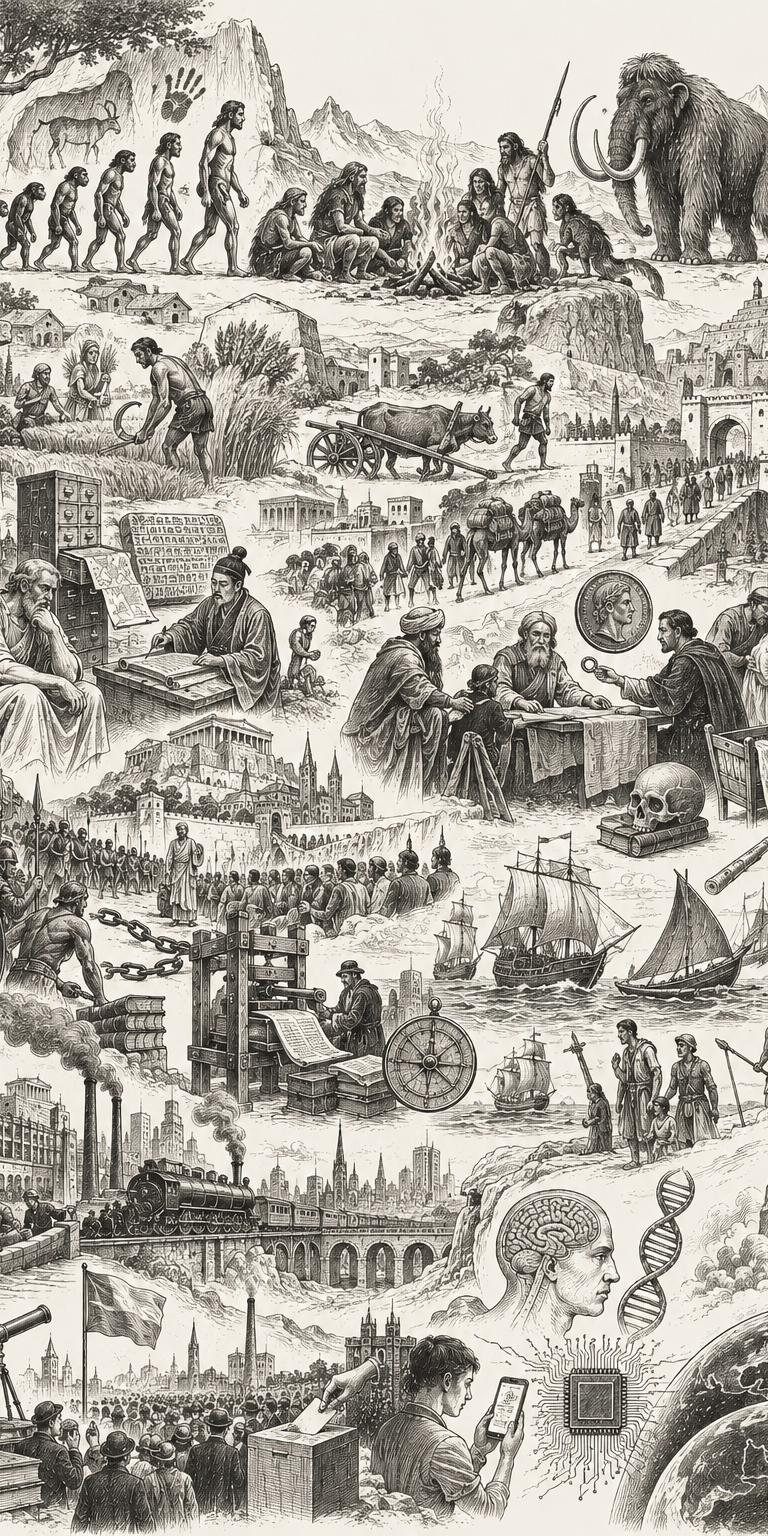
The Long Way Back to Ourselves
How an Unremarkable Animal Conquered the World and Lost Itself Along the Way
Ninety chapters. One a day. Free.
Apple Podcasts · EnglishSpotify · DeutschApple Podcasts · Deutsch
How did a biologically unremarkable animal become a being that determines the conditions of its own existence? And in doing so, is it losing the very ability to know what it actually wants?
Part 1
 1.1 Why Us of All Species? Human Kinds and a Brain Too Expensive
 1.2 Fire, Cooking, and the Invention of a Long Childhood
 1.3 The Cognitive Revolution: Language, Gossip, Shared Intention
 1.4 The Lion Man: The Birth of Fiction
 1.5 Shared Myths: How Millions of Strangers Cooperate
 1.6 The Stone Age Mind in You, and the Limits of That Explanation
 1.7 The Social Brain: Bonding, Rank, Shame
 1.8 Language Itself: How Words Are Born, Travel, and Die
 1.9 The Great Migration: How Humanity Took Over the Planet
 1.10 The Ecological Footprint Before Civilization
Part 2
 2.1 The End of the Ice Age: A Climate History of the Holocene
 2.2 Göbekli Tepe and the Limits of Archaeology
 2.3 Agriculture: Progress or Trap?
 2.4 Domestication: Who Actually Tamed Whom
 2.5 The First City: Çatalhöyük, Jericho, Uruk
 2.6 Sumer: Why There, Why Then
 2.7 The Anunnaki: What the Tablets Say, and What Was Made of It
 2.8 Writing: When Information Left the Brain
 2.9 How Inequality Arises, and Why It Always Passes Itself Off as Nature
 2.10 Patriarchy, the Hardest Case
Part 3
 3.1 The Law: From Hammurabi to the Idea of the Rule
 3.2 Bureaucracy: How the State Learned to See
 3.3 The Empire as Operating System
 3.4 Money: The Most Successful Fiction of All Time
 3.5 The First Networks: Bronze, Incense, Silk
 3.6 From Ancestors to the Great Gods
 3.7 The Axial Age: When the World Began Thinking at the Same Time
 3.8 China Thinks: Confucius, Laozi, and the Legalists
 3.9 India Thinks: The Self, Suffering, and the Wheel
 3.10 Monotheism and Its Price
Part 4
 4.1 Us and Them: The Psychology of the Group
 4.2 War: The Organization of Violence
 4.3 Slavery: The Longest Institution
 4.4 The Invention of Childhood
 4.5 Love, Marriage, and the Invention of Togetherness
 4.6 Emotions: Universal or Constructed?
 4.7 Death: Burial, Mourning, the Afterlife
 4.8 Art: Why Humans Make Images
 4.9 Music: Synchronizing the Group
 4.10 Intoxication, Ritual, and the Chemistry of Culture
Part 5
 5.1 Epidemics, Part One: The Price of Density
 5.2 The Polynesians: Humanity's Greatest Feat of Navigation
 5.3 The Other Seafarers: Phoenicians, Arabs, Chinese, Vikings
 5.4 Fourteen Ninety-Two: The Exchange That Rebuilt the World
 5.5 Epidemics, Part Two: The Biological Collapse of the Americas
 5.6 Africa Before Colonialism
 5.7 The Islamic Science System
 5.8 The Printing Press: When Copying Became Cheap
 5.9 Colonialism: The Mechanics of Rule at a Distance
 5.10 Silver, Sugar, Slaves, and the First World Market
Part 6
 6.1 What Can We Know? From Socrates to Hume
 6.2 Kant: The Turn Inward
 6.3 How Should We Live? Three Operating Systems of Morality
 6.4 The Scientific Revolution: The Admission of Ignorance
 6.5 The Needham Question: Why Not China, Not India, Not the Caliphate?
 6.6 Enlightenment and Its Opponents
 6.7 Capital and Credit: How Trust in the Future Creates the Present
 6.8 Adam Smith and the Invention of Economics
 6.9 The Industrial Revolution: Energy in Abundance
 6.10 The Clock, the Factory, and Consumption
Part 7
 7.1 Nationalism: The Imagined Community
 7.2 Humanism: Authority Migrates into the Person
 7.3 The Three Branches: Liberal, Socialist, Evolutionary
 7.4 The First World War: The End of a World Order
 7.5 Totalitarianism: When an Idea Takes Over the State
 7.6 The Holocaust: The Question No Explanation Closes
 7.7 The Second World War and the Bomb
 7.8 The World Under Deterrence
 7.9 Decolonization: The Invention of a Hundred and Fifty States
 7.10 The Great Acceleration
Part 8
 8.1 The Invention of the Individual
 8.2 The Narrating Self: Why We Live Memories, Not Experiences
 8.3 Free Will Under Pressure
 8.4 The Hard Problem
 8.5 Happiness: What the Research Shows
 8.6 Meaning, Work, and Contribution
 8.7 The Attention Economy: How Predictability Became a Commodity
 8.8 Truth, Media, Propaganda
 8.9 Intelligence Without Consciousness
 8.10 When Data Decides